Loodo
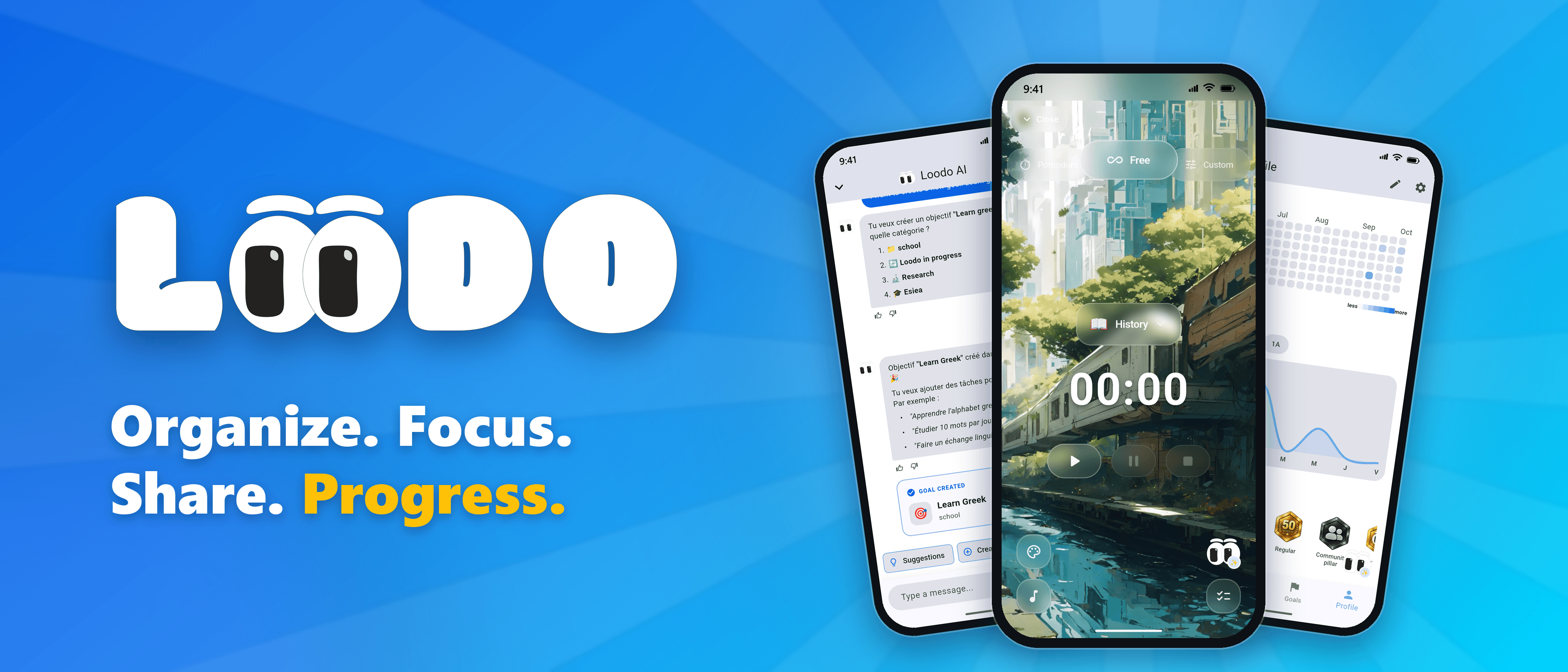
A social productivity app — a Strava for work — whose AI assistant performs real actions in the app instead of only describing them.
The idea
Productivity apps measure what you did; social fitness apps make what you did worth showing. Loodo puts the two together. Focus sessions are timed, saved with a photo or a short video, and shared with the people you choose: public, friends only, or private. They add up the way training does, through streaks, an activity map and badges. The social layer is how Loodo keeps people coming back, not a feature bolted on top.
An agent that acts
Loodo AI is a planning assistant running on Mistral through tool calling. The model does not answer with a paragraph telling you what to do; it calls the app's own operations:
- It creates categories, goals and tasks, including nested subtasks.
- It edits them and ticks tasks off.
- It reads your progress over a given period.
- It keeps a memory of you that you can view and delete.
A coach that fits on the phone
Calling a hosted model for every exchange costs latency, money and privacy. I prototyped an on-device coach by fine-tuning Mistral 7B with QLoRA using Unsloth, to find out how much of the experience survives with no network call at all. The same question drives Sign2Speak, from the other end: how small can a useful model get before the product stops working.
How it is built
Loodo is a single Flutter app that runs on iPhone, Android and the web, backed by Supabase for accounts, data and the AI assistant. It is shaped by conversations with its beta testers, recruited through a newsletter I built for it: each version starts from what they actually need, not from what I assume they want.
Status
Loodo is available on the App Store. The Android version is coming soon to Google Play.